My Blog
Alan Bliss
Enabling More Effective Discussion in the Classroom

Monday, December 6, 2010

Alan Bliss has been teaching for 28 years, the last 18 of them at Melbourne Grammar School in the Years 7 & 8 campus (Wadhurst). He is Co-ordinator of History and also Co-ordinator of Teaching and Learning at the campus.
Since 2003 he has been a member of a professional learning network called The Ithaka Project. Through this network, Alan has focussed on reflective classroom practice, based on the work of Project Zero at Harvard. The work of Ron Ritchhart has been a particular focus, exploring how dispositional thinking and thinking routines as described in Intellectual Character What it is, Why it matters and How to get it (2002) can deepen student thinking and understanding.
Discussion in my classroom plays an important part in providing students with the opportunity to develop their thinking and understanding. Equally, it provides me as teacher with an opportunity to check on student understanding and misunderstandings. However, in middle school effective discussion practices do not simply happen. In this paper, I explore how I endeavoured to create the environment and procedures that would allow for effective discussion to take place with one Year 8 class, both as a whole class and in smaller groups.
For some years I have believed that for students to fully collect and process their thoughts into a coherent whole, they need to write. In doing so, they can make visible their thinking. Understandings and misunderstandings are revealed, together with flaws in reasoning and gaps in knowledge.
I still think that. However, over the last few years, I’ve begun to see more clearly that discussion in class can be a critical step for students in both developing and checking their understanding; and for me, as teacher, in checking on student understanding and misunderstandings. In addition, I have been trying to find ways to allow students to take more responsibility for learning, both for themselves and for others.
So, the notion of a more critical and defined role for classroom discussion linked to greater student responsibility for learning has led me to try and develop a climate in the classroom where students interact with each other more readily and build understanding (for themselves, but also for each other). In doing so, I am hoping that my role as teacher in discussions will change from the focal point to much more in the background. Student talk will increase and teacher talk will decrease (See Appendix 2).
“...To practice critical thinking, students need to participate in the discourse of the discipline--to think, speak, and be listened to as they participate in the discipline's particular mode of inquiry. Students will not get enough practice just by talking to the instructor, and very little by just listening to the instructor. Students develop competency and become critical thinkers in a classroom that provides opportunities for intensive, structured interaction among students...” (Bishop, 2010).
At both Year 7 and Year 8 levels, this seems difficult to do easily. Students seem to:
•Naturally want to look to the teacher as judge and jury rather than to each other...perhaps learned behaviour?
•Want to offer responses without acting in a way that adults might in a similar situation. Typically, talking over each other without an adult reaction, such as “sorry, you go...”
•Struggle to really listen to each other’s talk. That is, really hearing what is said...active listening. They do not often therefore respond to what is said by others. Rather they seem determined to air whatever thought is in their head at that moment.
In looking to have students make more effective use of each other as resources for learning (as well as recognising the value of an authentic shaping and re-shaping of their own views), my wondering has been about how I can facilitate student talk in the classroom in ways that are both productive and effective in contributing to greater student understanding.
Opportunities
“...Student desk arrangement, a nonverbal factor in the classroom organisational scheme, can significantly affect student-to-student interaction and thus group and individual behaviour...” (Grubaugh & Houston, 1990)
With the above in mind and before the first student day at the beginning of this school year, Tim (with whom I share a classroom and who I believe thinks in similar ways to me in terms of expectations and effective classroom practices) and I decided to alter the environment of the classroom. During the previous year we had experimented with a floor plan encouraging more student interaction by changing from the traditional rows to effectively a rectangle with a row of tables in the middle. We had to have that (we thought) because of restrictions in the space of the room. Whilst it was more effective in some ways in terms of encouraging student interactions, the middle row was a problem and there was still the back row!
This year, we removed the middle tables and seats and created a rectangle with seats initially placed around the outside of the tables – students were facing inwards and towards each other (we disregarded the less than ideal space and ignored the squeeze). The teacher desk also became part of the rectangle. If discussion/student talk was to be effective, we felt that the boys had to be looking at each other, as any normal conversation would occur.
Early observations
In order to gather some initial data and develop my thinking, I observed two of Tim’s Year 8 classes in consecutive lessons on two separate occasions. Tim had felt that one class (A) were more likely to engage in effective discussion practices than class B.
Some findings:
•It became very clear that there was no way to hide. By facing each other, students are immediately accountable to each other and to the discussion.
•Boys who were asked if they had contributed or not eventually did contribute – in one case, two previous contributors spoke and then the six who hadn’t contributed did so...after each other!!!!
•Class B was characterised by boys who often produced comments not connected to the previous offering, whilst class A were better at doing just that. Their discussion included a number of examples of opening comments such as; “As XXX said, ....”, “One problem with what XXX said was....” , “That was my point”, “Building on what XXX said....”. Class A seemed to be listening more actively and were willing to use other student’s thinking to build on their own understanding.
So on the positive side it seemed there was a feeling of immediate accountability, and student interaction was unavoidable. Students looking at each other gave a clear sense of contact with each other, whether they liked it or not. There was no back row! Students could not hide or be talking to the back of someone’s head. In the early discussions with this environmental structure, there was no escape - distracted students there may have been, but they were unable to function as distracters. In addition, non-contributors seemed to feel the pressure to get involved.
However, the “orderly process” of the discussions remained a challenge:
•Students were still clearly expecting the teacher to be the focus
•As often as not, boys would talk over each other without the normal adult methods of concession (eg. “sorry, you go....”)
•Also as often as not, there was no clear building on the comments of the previous speaker – rather, unrelated comments were given, regardless of clear opportunities to agree, disagree or ask for clarification.
So, environmentally, we had made strides, but without coming to grips with other issues. At this point, it is dubious whether we could call what was happening a discussion.
Trialing the Microlab Protocol
Discussion does not need to be whole class of course. The use of smaller groups to work collaboratively and co-operatively to achieve greater understanding is also a means by which student talk can be increased in the classroom. There are many ways to construct groups ; by ability, by friendship, by seating at that moment and others.
One method that seems to be effective is through the use of the Microlab protocol developed by Julian Weissglass for the National Coalition for Equality in Education and adapted by Tina Blythe. In this protocol, each student is given one minute (or longer) to explain their thinking about a particular given topic/issue. In between speakers there is a period of reflection to consider what has been said. When each speaker has finished and the group is done, there is a period of discussion when questions can be asked of each other, comments made and anything else which would reasonably occur within a discussion. If adhered to carefully, students have no option but to hear the views of others in a controlled manner, demonstrating perhaps how discussion might best occur to the greatest effect. The Microlab protocol is not suitable for a whole group discussion however.
This protocol is certainly effective procedurally in managing group discussion. What is not so clear is if the groupwork is producing deeper understanding for the participants. Regardless of how effectively it might be managed, if the protocol is not effective in its intent, then it is doubtful that it should be persevered with. In a recent case, I asked students to write for five minutes before the protocol occurred, and then for five minutes afterwards. A majority, but not all, indicated that they felt that their second piece of writing was better informed than their first piece.
To attempt to provide me, as teacher, with a more informed opinion as to student understanding, I set up a wiki. Each student was invited to make a comment or to respond to comments - that is, to seek clarification, to take issue with a comment or to build on comments. I was hoping that this would provide an opportunity for students to see how a discussion might take place in written form. This unit has only just been completed, but it not clear that students have used the wiki in the manner I was hoping with regard to the practice of discussion. The data seem to be showing that the wiki reflects the same student actions as previous whole group verbal discussions. Students are only rarely responding to what was posted only minutes before, not seeking clarification of other posts, nor do they seem prepared to argue against other posts by using evidence.
Thinking about Evidence
If the above is how the effectiveness of group discussion might be evaluated, how do we then measure the effectiveness of a whole group discussion? Perhaps the following might be seen in a discussion that would make it effective and successful:
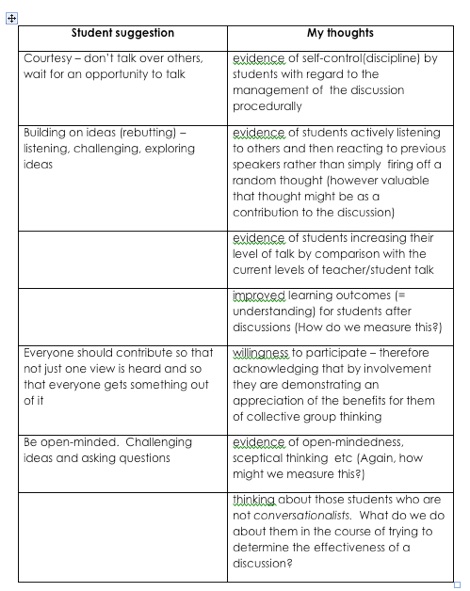
•evidence of self-control(discipline) by students with regard to the management of the discussion procedurally
•evidence of students actively listening to others and then reacting to previous speakers rather than simply firing off a random thought (however valuable that thought might be as a contribution to the discussion)
•evidence of students increasing their level of talk by comparison with the current levels of teacher/student talk
•improved learning outcomes (= understanding) for students after discussions (How do we measure this?)
•willingness to participate – therefore acknowledging that by involvement they are demonstrating an appreciation of the benefits for them of collective group thinking
•evidence of open-mindedness, sceptical thinking etc (Again, how might we measure this?)
•thinking about those students who are not conversationalists. What do we do about them in the course of trying to determine the effectiveness of a discussion.
Looking for solutions…
Given that it seems to be that the key issues seem is that students do not have a clear notion of what holding a discussion means, and what might be the purpose and advantages of a discussion, I settled on the following action plan:
•Immediately prior to the next topic to hold a discussion about discussion, with students doing some brainstorming of ideas and exploring what the key elements of an effective discussion should be (perhaps using the Generate Sort Connect Elaborate thinking routine)
•On the basis of their thinking above, to invite students to develop a set of guidelines for conducting a discussion which would make it effective
•To test the guidelines in the first appropriate discussion point during the topic and then again invite students to review their effectiveness (or otherwise), making changes as necessary (this may need some additional teachers observations to report back to students).
As teacher, I may need to assist in the development of the guidelines….determined by the direction of student thinking.
Establishing Guidelines
The first step in this process was to explain to students that I was unhappy with the way in which discussions had been occurring and why that was. As a result, we were going to spend a lesson or two exploring the idea of discussion.
I did this by using the thinking routine Generate Sort Connect Elaborate developed by Ron Ritchhart (Ritchhart, Church, and Morrison, In press)
•Generate an initial brainstorm
•Sort students arrange their brainstorm lists around a centre point according to whether they rate the point as more or less important in a discussion. Closer to the centre means more important
•Connect students see whether there are any connections between the listed/placed words, draw a line between them and then write on that line exactly what the connection is
•Elaborate this gives students the opportunity to add anything new which has occurred to them as they have worked through the sorting and connecting steps.
With the routine worked through, I then asked, “given that you have spent some time now thinking through the idea of a discussion, what class guidelines would you suggest to make our next discussion as effective as possible?” (See Appendix 1 for a list of all student suggestions)
In the following lesson and having made a list of all student suggestions (in the process of which a number of similarities became apparent), I asked the students to see if they could group the various suggestions. The final step was to try and summarise the groups into a single sentence.
A discussion followed during which we were able to settle on four guidelines we would use during the next discussion to try to make it as effective as possible. Interestingly, their offerings compared favourably with some of the elements which I thought would make for an effective discussion. (See Table 1)
Ultimately, as a class, we settled on four key guidelines to follow and then perhaps review after the following discussion:
•Active listening
•Everyone involved
•Responding – building on ideas and rebutting
•Courtesy.
What happened?
With an observer present in the room to give a more objective view as to whether the guidelines as they were had been successful, the next class discussion was moderately successful. Students demonstrated that they were actively listening, showing a greater consciousness of responding to comments. Contributions took place across the class indicating an awareness that everyone should at least try and be involved. Courtesy still seemed an issue. Students were still inclined on occasion to talk over each other and not concede the floor with a “sorry, you go” or something similar. Hands were raised to make a contribution which meant that the focus remained on myself as teacher. Still, even in adult discussion groups there is often a facilitator so perhaps greater student to student interaction is the point of measurement.
Anecdotally, notable incidents occurred in discussions in the weeks following:
•One frustrated student from this class announced to his Science teacher after a discussion in that subject that his peers “had forgotten everything we had talked about in History about holding a discussion”
•Students became aware and publicly noted when they thought that students were responding in discussions without any apparent reference to what had been said immediately prior to that response...”he didn’t build on what’s just been said.” In fact, sometimes they were right and sometimes they simply hadn’t quite understood the response. Regardless, at least they were aware of the guidelines we had collectively established.
Next Steps
Given that this approach seems to have been reasonably successful in at least drawing students’ attention to how an effective discussion might be conducted, I will again use this same process for establishing discussion guidelines early in the next school year with all classes. A particular focus will be with Year 7 classes to try to establish effective processes as early as possible and build on the procedures through the following two years.
Another aspect of trying to create an effective discussion has been suggested by colleagues. Some students, perhaps with the best intentions, struggle with the language of responsive discussion. So, a further aspect of enabling more effective discussion might be to both provide and discuss a set of prompts for building discussions which result in deeper thinking and greater understanding. That might occur in two ways:
•Prompts which enable more effective questions. By effective, I mean those questions which will acknowledge what has just been said but will push the respondent into deeper thinking; and
•Prompts which simply give the opportunity for a student to respond appropriately....such as, building on what John has just said, or as James said earlier.
Conclusion
If discussion is to become an effective means of enabling student thinking and providing the opportunity for students to better develop understanding, then attention needs to be paid to facilitating its operational effectiveness in the classroom. Creating a seating environment which enables the basis of any discussion, eye to eye contact, seems an important first step. Exploration of the idea of discussion seems also to have been a useful further step in the process in drawing students’ attention to guidelines for effective discussion. It does not end here however. The provision of discussion prompts may also be a way to be inclusive of those students who initially lack the language to see themselves as being able to take a meaningful part in a discussion. I intend to trial the latter in the next school year to see whether that will eventuate.
References
Grubaugh, S. & Houston, R. (1990). Establishing a Classroom Environment That Promotes Interaction and Improved Student Behavior. The Clearing House, Vol. 63, No. 8 (Apr., 1990), pp. 375-378
Bishop, P. (retrieved 2010). Classroom Interaction in The Learning-centred Resource Bank http://faculty.valenciacc.edu/pbishop/lcrb/clssrm-interact.pdf
Willson, J. (1999). High And Low Achievers’ Classroom Interaction Patterns In An Upper Primary Classroom. Paper presented at AARE Conference, Melbourne
Appendix 1 What makes an effective discussion (student responses)
-
•Bring up an issue or topic
-
•Sit in a group preferably in a circle
-
•Wait for people to finish talking or listen to everyone
-
•Be sceptical and challenge people if you disagree with their opinions
-
•If you agree, let people know and state why
-
•Make sure everyone has a turn speaking
-
•Bounce off each other and build on ideas
-
•If you have something to say, say it
-
•Ask questions
-
•Everybody chip in
-
•Express yourselves
-
•Everyone must contribute and listen
-
•Contributions should be sensible
-
•Different opinions must be challenged
-
•Everyone should come up with new ideas and contribute
-
•Everyone must think open mindedly
-
•No-one else talks when one person is speaking
-
•Everyone listens to one person
-
•If others want to talk and add their own opinions then they put their hands up
-
•Use groups to start off with, so working groups to first discuss the topic, then work as a whole class after, so then everyone is involved
-
•Group people with people they actually work with
-
•All ideas are heard from each group
-
•Gather two or more people
-
•Find a topic to debate, conflict and brainstorm about
-
•Agree, add to or rebut people’s opinions
-
•Challenge other people’s opinions with differences
-
•Negotiate your thoughts to find the solution or answer
-
•Depending on your different views and conflicts, create a final solution or leave the discussion open
-
•Listen
-
•Share ideas
-
•Freedom of speech
-
•Express your ideas
-
•Be open-minded
-
•Be also sceptical
-
•Explore your answer
-
•Think further than your answer (if you can)
-
•Arguing people’s ideas (if you don’t agree)
-
•Use these rules
-
•Everyone contributes
-
•Listening to others
-
•Questioning thoughts and ideas
-
•Presenting different ideas
-
•Proving your point
-
•Everyone must listen to others ideas/opinions
-
•Question other people’s opinions
-
•Every participant must contribute to the discussion
-
•People need to be open-minded
Appendix 2 Teacher talk vs Student talk – an example
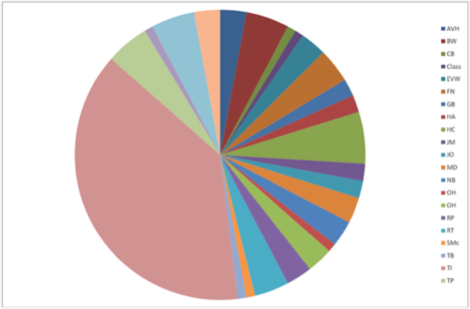
(By permission from Mark Coleman, who undertook this observation on a colleague, Tim Inglefinger, in a class focussed on discussion. This observation too place in the room described in this paper, with students sitting on the outside of a rectangle and the teacher part of that rectangle).
The large area of the pie chart represents teacher talk as opposed to contributions from individual students.
Download the PDF here