My Blog
Julie Arcadiou
Each school year we begin with a new group of children and a new set of ideals! We think about how the year will be and where we want to take our children. We begin with drive and direction about where we are heading. We ask ourselves, will I be able to develop strong values in my children? Will I be able to assist the children in my class to reach my expectations? Will this group develop the independent thinking and questions I hope for?
Through my years of teaching in Prep I have noticed many changes in my approaches. Last year, as part of working with Ron Ritchhart, I explored how the children in my class (five and six year olds) developed questioning. I focussed on the language of thinking and teaching the children to form questions by using the Question Starts and Think-Puzzle-Explore routines. I explicitly taught the language and structure of questions through our science lessons. I was truly astounded at how capable the children became at forming questions.
This year, with a new group of children and a new set of ideals, I am focussing on analysing the development of their questions. I am attempting to use a more concrete method of tracking the questions of individual students, rather than simply whether the whole class asks more questions.
•What kinds of questions are they asking?
•To what depth do their questions demonstrate?
•Where do they take their questions?
Questioning is at the centre of research. It is a starting point, a point of inquiry. It is not only important that students develop the language of questioning, but that they differentiate between closed or surface questions and open or complex questions. I would like to see students reach the point where they are asking questions that challenge our mindset. Monitoring and analysing these questions is the next challenge!
I have been tackling this by incorporating rich picture story books into our Literacy lessons - picture story books that relate to a scientific focus or moral or ethical idea. These have a central big idea such as day and night, loneliness, truth and lies, peacefulness, memories, dreams and hopes. Using the See-Think-Wonder routine (http://pzweb.harvard.edu/vt/VisibleThinking_html_files/03_ThinkingRoutines/03c_Core_routines/SeeThinkWonder/SeeThinkWonder_Routine.html), we examine the cover. The children are quite familiar with See-Think-Wonder, as we have used it with our big books in our morning literacy blocks; however, I had not yet explicitly taught the asking of questions. It is used as more of a discussion, getting the children to tune into what is happening on the front cover. In contrast, during the sessions using our picture story books, we initially focus on the illustration and the title of the book. Our discussion still follows the See-Think-Wonder routine, but it is quite flexible. For instance, the children sometimes present a wonder first and I prompt them to provide detail on what they saw initially on the cover that stimulated their wondering.
Often we break into small groups to discuss the front cover before we discuss as a whole class. They then move to their tables to create an illustration about their wonderings. They enjoy this part immensely as they have an opportunity to draw using pastels! This adds to the ensuing discussion, as children have time to represent their wonderings and think about them in more detail while creating their picture. We then come together and read the text. Following the reading we revisit our wonderings, discuss the ideas in the text, and how they link to the wonderings. This process has been undertaken several times so far and already there are interesting notes. I video the children while they are discussing what they can see, think and wonder, and use this to form the basis of my analysis of their questions. This has been a very useful tool as I have been able to revisit these videos on many occasions.
Initially I went in search of a ‘tick the box’ outline to analyse the children’s questions. I thought there would be something that I could just slot the children’s questions into that would clearly demonstrate if the question was deep or surface level. I was directed to Ron Ritchhart’s ‘A Typology of Questions’ and initially thought this was the answer. I thought it would help me to categorise the children’s questions as it clearly identifies different types of questions that are often seen in the classroom. However, it soon became apparent that this was not the right choice.
As I continued into the journey Ron Ritchhart explained the ‘8 Continua for Thinking’, (refer to attachment 1) which he felt would give me a way to examine the questions children ask. This wasn’t at all what I was looking for, or so I thought. I didn’t believe it was clear enough for me to be able to analyse the children’s questions.
I spent a lot of time watching the videos that I took during each teaching session. I sat back and examined what the children were saying and observing their development in their questions.
When I took another look at the ‘8 Continua for Thinking’, I began to see a way in. In particular ‘Continuum 7: Wondering’ allowed me to highlight the development of student questions, by identifying whether they were at the narrow and closed end of the continuum or the broad and generative end.
My struggle with the search of an analysis tool was exactly that - my own inability to look at something from a different angle. It was my lack of capability to be flexible in my perspectives. Once I took the time to reflect on what I really wanted to do, I could see why Ron had made the suggestion.
My focus has been on three students who are quite different from one another. Cooper is a very high functioning student who has strong verbal skills and is reading and writing at a very high level. Abby has found reading and writing quite challenging and often needs extra assistance in understanding concepts. Beau started quite slowly in his development of reading and writing; however, he has made great leaps over the past term.
The beginning chapter:
The focus was to establish a baseline for analysing student questions.
The Paradise Garden deals with ideas of family, peacefulness and a sense of belonging.

Figure 1 The Paradise Garden
Our first lesson began with the whole class on the carpet. I showed them the book, told them the title and author, and explained that in their small groups they would talk about what they can see, what they think and what they wonder. The children broke up into small groups to examine the front cover. Each group had time to discuss the text before we returned to the carpet as a whole class. When we returned I asked the children to express what they were wondering;
“I wonder that he is walking home from school,” Cooper
“I wonder if he is going to go to the house?” Beau
“I wonder why he is walking past flowers?” Abby
“I wonder if he is walking all the way to the street and the sun is setting?” Kristy
“I wonder that it is an old place ‘cause it looks rusted,” Zac
“I wonder if there’s crocodiles in there?” Julie
“I wonder if he’s going to a house and it’s a little bit rusty?” Max
“I wonder that the boy is going for a walk,” Susie
“I wonder...I forgot,” Tia
Their responses clearly showed that they were not yet competent at forming and asking open, inquiring questions. I rephrased the students’ wonderings by saying things like, “Are you wondering why he is walking all the way?” and “Are you wondering if it is an old place?” These prompts helped students focus on forming questions rather than restating what they think and see with ‘I wonder’ at the beginning.
There were mainly statements during this initial session; however, I did want to begin analysing the children’s questions that were presented. When I started looking at the questions the children had asked using the A Typology of Classroom Questions I found it difficult to put them into a category as the categories are teacher based questions. I then turned to the Continua For Thinking document to see if I could use Continuum 7: Wondering. This Continuum made it much easier to be able to analyse the questions and identify where they were. From the focus group it was interesting to note that Abby and Beau both formed a question, albeit a very narrow question, on the baseline of the continuum. Cooper however, only gave a statement. This surprised me as I assumed Cooper would form questions easily, given his other strengths.
Building the foundations:
The focus was to begin teaching the language and structure of questioning.
The Dragon’s Lie highlights ideas of loneliness, truth and lies.
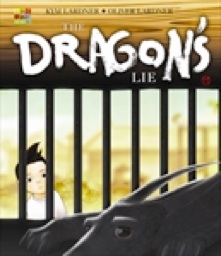
Figure 2 The Dragon’s Lie
Over the next two weeks we continued focussing on forming questions and discussing the big ideas in the books. We used question starter dice to help us form our questions, we had posters up on the board reminding us of our question words, and we explored the structure of a question including punctuation.
I continued to prompt and probe students to form questions correctly. When they asked questions as statements, I re-worded them and asked if what I was saying was correct. The students quickly picked up the structure of a question and their language became clearer and more accurate. The majority of their questions were based around ‘I wonder if...’ These questions were still quite literal, centred around what could be seen on the cover, rather than the ideas or concepts in the text. However, a big change was that most of the children were in fact asking questions.
These wonderings were presented during our See-Think-Wonder of The Dragon’s Lie:
“I wonder if the dragon is sad?” Cooper
“I wonder if he is going to try and break out?” Beau
“I wonder if the dragon is lonely?” Abby
“I wonder if the dragon is going to come out?” Susie
“I wonder if the dragon might eat the boy?” Freya
“I wonder if the dragon is trying to get out?” Kane
“I wonder if the dragon is in jail?” Kristy
“I wonder when he is going to die?” Tia
Beau had once again asked a question although I felt that his question was quite literal and narrow. Two of these questions that interested me greatly came from Cooper and Abby. Their questions were based around inferential observations. They were inferring that the dragon was sad and lonely and interested in the emotions related to the text. Looking at the continuum made me see this as a real shift. Abby had moved from asking a very narrow and closed question to one that was posing much more depth and thought. I saw her question as being towards the middle of the continuum. Similarly, Cooper had also moved onto the continuum with his question and in the last session Cooper didn’t form a question at all. This certainly showed development in their questions. As a class we went on to discuss the emotions and why we thought the picture was making us sense these emotions. Many children were happy to offer their thoughts on things that make us sad and lonely and ways we can feel better. We were starting to get to the big ideas through the children’s questions!
Extending and challenging:
The focus was to develop the types of questions being asked.
Memory Bottles links ideas of memories, thoughts, life and age.
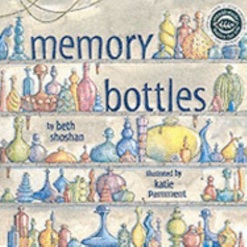
Figure 3 Memory Bottles
The exploration of Memory Bottles took us to a new level in terms of the children’s questions and development of their ideas. Many children focussed on the big ideas represented by the title and illustrations rather than the literal images on the cover. More children were willing to participate and all children were happy to sit and wait their turn to speak. The class were all interested in what people where saying and the wonderings that people had.
These wonderings were presented through the use of the See-Think-Wonder routine using Memory Bottles:
“I wonder if they give all your memories back?” Cooper
“I wonder why there are no people there?” Beau
“I wonder if the shelves are glass?” Abby
“I wonder how they set up the shop?” Tom
“I wonder if they are very delicate glass bottles?” Zac
“I wonder if they are going to sell your memories?” Kara
“I wonder why the bottles are actually there?” Tia
“I wonder how the bottles are made?” Susie
“I wonder why they left the bottles with all the memories there?” Kristy
“I wonder if the lid comes off if the memories escape?” Max
“I wonder if they take all of your memories and you only have some left?” Mark
The level of interest in the memories was truly exciting. The children were very fascinated by the idea that there could be bottles with memories inside them. Their wonderings reflect their interest and engagement, however, I also believe that their wonderings reflected a growing understanding of the ideas in text and the way we structure our responses to the text. They were now able to avoid just looking at the literal content of the text; they were able to infer, reflect and draw on their own knowledge of the big idea. The children were able to identify the concept in the text and wonder and question why. Cooper, Abby and Beau all posed questions. Abby’s question in this case was more literal with an easy answer. Beau also asked a question that seemed quite simple and closed. On the other hand, Cooper’s question showed interest in the key idea in the text. He once again asked a question that seemed further along the continuum. His question displayed personal interest that can also guide discussion and inquiry.
The ensuing discussion was about our memories and where we keep them. The children eagerly discussed the brain and how our memories ‘live in it’. They also highlighted that sometimes we can’t remember things and at times we have to think very hard to find the memory, just like in the shop. Their wonderings were now allowing for depth of discussion, a variety of perspectives and detail of ideas. They were also listening and responding to each other in a far more sophisticated way. Instead of jumping in over the top of one another they were listening. Once a classmate had finished speaking then they responded to what was said or added a new thought.
Moving beyond expectations:
The focus was to move towards the children listening, speaking and questioning each other.
Where does Thursday go? identifies ideas such as day and night and time.
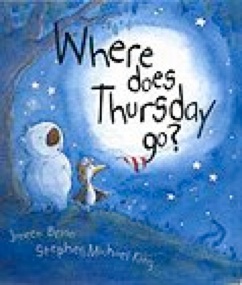
Figure 4 Where does Thursday go?
Our lesson on the text ‘Where does Thursday go?’ started with a book exploration. I showed them the front cover and said we were going to partner up to look at the text. The children automatically started discussing what they could see, what they thought and what they wondered. Interestingly some of the children were asking each other, “What can you see?” “What do you think?” “What do you wonder?”. They were taking a leading role in the conversation and able to work through the process themselves. This was the first time I had seen the children take control of the task without me as facilitator.
We then came together to share our wonderings and below are those wonderings presented:
“I wonder if Thursday stays in the one country at night?” Cooper
“I wonder how the stars got made?” Beau
“I wonder how the moon got made?” Abby
“I wonder if Thursday goes to a different country when it is finished here?” Oscar
“I wonder if Thursday is only on our planet?” Kane
“I wonder what the bear is looking at?” Melanie
My initial response to their wonderings at this point was one of great excitement and pride. They were certainly not narrow and closed. Abby, Cooper and Beau all asked questions that I considered to be big and encompassing. They were complex and perfect for inquiry.
During this conversation Kristy presented her wondering, “I wonder why there is a sticker on the book?” Melanie quickly put up her hand and responded, “I know why it is there!” I asked Melanie if she would like to explain it to Kristy and Melanie went to Kristy and sat in front of her explaining about the book prize sticker. This sharing of knowledge was such an exciting shift as they were beginning to respond to each other and I was able to step back.
After reading our book we came together to choose one of our wonderings for discussion. A lot of the children were interested in discussing where Thursday goes.
Max confidently said that, “Thursday goes to another country before us and then after us”.
Beau built on this idea by saying, “Well, Thursday has to go to another country because then it is someone’s birthday there.”
Kane added, “I agree with what other people are saying because it can’t stay here so we can have Friday”.
Susie then stated, “I know Thursday is going to another country, because when the sun sets it goes somewhere else.”
The conversation also turned to a focus on the sun, with Melanie adding, “When we have day other people have night and when we have night they have day.” Abby continued explaining that, “It is the countries on the other side of the world having night when we have day.”
It was interesting to see the links the children were making between our science concepts we had been focussing (day and night in particular) and the ideas in the text. Their wonderings and questions had reached a stage where they were forming them around central ideas.
Concluding the journey:
It has been an interesting journey to see the children develop their thoughts, questions, speaking and listening skills and language. They have been able to take ideas and images presented to them and ask thought provoking questions that truly challenge their prior knowledge, ideas and mindset.
Following our sessions we often displayed our thoughts, pictures and questions in the classroom, adding ownership to these. We also returned to address our questions as time passed, allowing the children to see ongoing value in the questions they ask and their ability to locate answers and respond.
It has been interesting to evaluate the children’s questions along the way. Abby, Beau and Cooper are now all capable of forming questions. They understand the language and structure that is required. Their questions, however, do vary in depth and complexity. I feel that while Cooper sits predominantly at the broad and generative end of the continuum, Beau and Abby both probably sit at a 3 on the continuum. They both ask more complex questions; however, they do not do so consistently, and sometimes their questions are not as deep. Part of this is perhaps due to their varying abilities emotionally, conceptually and academically. I also wonder whether this is linked to their interest in a specific topic, idea or text. Does my choice of text also impact on their ability to form complex questions?
Through this journey I have been able to observe the many changes in the children’s questions and act upon them as they progress by modelling, demonstrating and supporting the children. It has also allowed me to observe my own changes in the way I scaffold their questioning and thoughts. Sometimes that means stepping back and allowing things to unfold, diverging off the path possibly planned and seeing where it takes us. Sometimes I am needed to scaffold the conversation and bring it back on track!
In addition to the analysis of the development of the children’s questions, this journey has taught me a great deal about myself as a teacher. My initial difficulty in adopting the suggested analysis tool was a real turning point for me. It allowed me to reflect on my own approach to tasks, the way we often see things from one perspective with one goal in mind. When I was able to finally open my mind to what was presented I felt a huge sense of achievement.
As teachers I feel it is important to allow time for ourselves to journey, change, evaluate and develop, just as it is for the children we teach. Their growth is also reflected in my own growth.
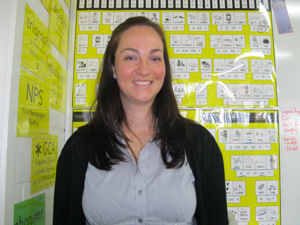
Julie Arcadiou is in her eighth year of teaching, currently teaching in a Year Prep classroom at an independent school in Melbourne, Australia. Julie has taught predominantly in the Independent system, however, she has also taught in Liverpool, England.
Julie has a great interest in assisting children to become independent learners. She has completed a Post Graduate Certificate in Education with a particular focus on Gifted and Talented Education and developing thinking skills in children.
As part of her work with Ron Ritchhart In 2010 Julie wrote a story titled ‘Fostering Curiosity & Developing Depth: Thinking Routines with Young Children’. This year Julie has once again worked with Ron Ritchhart to continue developing questioning in the Year Prep classroom.
The Journey from “I Wonder That” to “I Wonder How?”
Thursday, December 1, 2011

Download the PDF Here