My Blog
Andrea Dart
One of the most challenging things about teaching is having 300 or so conversations a day and making sure that they all end well. 300 is and isn’t a random figure. I have never counted but I estimate that if I spoke with each child in my class ten times during the course of a day, and added in conversations with colleagues and with parents, it would be something close to that. The number really isn’t the point. For me, the essence of teaching is about relationships centred on learning. The potential for every conversation to strengthen or weaken the relationship and the learning is, for me, what makes it both so challenging and worthwhile. Conversations have an important role to play in creating a culture of thinking in my classroom.
Trust is a key element in a learning relationship. Whether they express it or not, my students trust me to lead them in ways that are helpful to their development. They trust me not to waste their time, not to make it harder for them to learn than it already might be, to make sound judgements about what is most helpful for them, and to be the adult in the room. The responsibility for the conversations ending well starts and ends with me. It is about the tone that I set, the expectations that I have of them, the responses I give to them as individuals, how they are treated in my care and how I shape and respond to their interactions. It is about me pushing them out of their comfort zone at some point so that they can take risks in their learning and be free to make mistakes. Establishing a culture of thinking in my classroom is about having conversations centred on thinking and learning. It is also about respecting and not underestimating what my students are capable of discovering or how deeply they might explore, and how much they can teach me in the process as well. Conversations that end well are ones that advance and shape their learning journey as thinkers, encourage their self-belief, perseverance, creativity, questioning, excite a love of learning, and celebrate being in a space of not knowing, and discovering.
Fighting anonymity
In the context of working with small groups of students, conversations can sometimes be quite tricky. There can be several reasons for this (more of that, later). One is that there is nowhere to hide for an individual student who may not be comfortable with sharing ideas or responses with peers. A small group may be an intensely uncomfortable place for a shy student. The relative anonymity afforded them in a mainstream classroom, which can be a hiding place for some, is simply not available. It can be too difficult to fly under the social radar when the full attention of a handful of peers is focused upon them. As Hattie points out “In so many classrooms, the greatest reason why students do not like to expose their mistakes is because of their peers: peers can be nasty, brutal, and viral” (Hattie, 2012, p 26). Particular care is needed, then, on my part as the teacher to create a culture within my small group where it is safe for students to share their thoughts, to question, and to interact with their peers. This is an essential element in fostering a culture of thinking.
At the start of the school term, I approached my new literacy support group, confident that I could create such a culture within the class. With a small group of five Year 8 students and a good amount of experience to draw upon, I felt certain that the group’s collective conversations and my 1:1 conversations with them would soon be centred on thinking and learning. Ritchhart, Church and Morrison point out that “interactions within a culture of thinking are not just about being civil…(they) need to facilitate individual and group learning.” (Ritchhart, Church & Morrison, 2011, p 245). Mindful of this, I wanted to take them to a place of respectful interaction centred around the content of the English Study Skills program.
Checking in
In the initial classes, I worked to establish the norms for how the group would operate and interact. I opened the lessons with routines and structures which aimed to set a quietly respectful and collaborative tone and focus the agenda on their thinking and learning. These procedures involved greeting each of the students by name, listening as they told me how they were or how their day was going, acknowledging what was important to them at that moment, and then focusing their attention on the learning objectives. The “checking in” conversations were typically quite brief. Where achieving the learning objectives involved group discussion, it was important to ensure that students took turns in contributing to the conversation so that each student had a voice and was being listened to by their peers. I devoted some time to valuing respectful participation by explaining my expectations about their interactions.
Interests and tolerance
A time mapping exercise in the second lesson was designed to help me to learn more about the students’ interests and routines, particularly outside school. As one of the main objectives of the English Study Skills program is to support students as individuals in their literacy development and in their broader learning, it is important to get to know the students quickly. Tapping into their interests is a good place to start as most will happily talk about things they enjoy doing. This helps me begin to develop an effective rapport with them, based on some knowledge of who they are as individuals. A further intention of the exercise was that the sharing of their observations about their use of time would also help the students to understand more about each other. Whilst much of their schooling experience is held in common as peers in the same home groups, it is important for them to appreciate that their lives beyond school are quite different. This in turn can help them to be more accepting of each other and more tolerant of different perspectives. Developing students’ understanding that others bring different experiences to their thinking about common material is important in establishing a culture of thinking.
The exercise involved students completing a weekly planner template which showed an outline of how they would typically spend their time before and after school, and on weekends.
Figure 1: Mapping regular commitments and routines
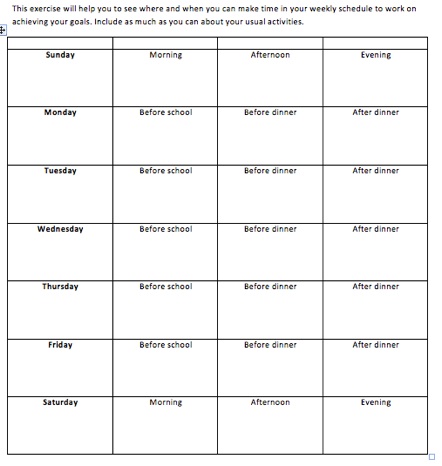
On completion of the template, I asked the students what they had noticed about how they spent their time and invited them to share their observations. It was also an opportunity for them to ask questions of clarification about others’ comments. Taking care to ensure that each student contributed to the group discussion, I paid quiet attention to their body language, noticing the tone of their voice, facial expressions and where their eyes were directed as they spoke. I was also mindful of the extent of their eagerness to contribute.
Four of the students seemed to enjoy comparing notes, talking quite readily about some of their routines or favourite pastimes. It was fairly easy for Monique to talk about the time she spent having dance lessons, and for Lewis to share the training and playing schedule of his basketball team. He happily elaborated on their success. Sam’s face brightened when he spoke proudly of fishing, and Tim was very eager to talk about his soccer team and how much he enjoyed parties and social events.
For Kelvin, however, it seemed to be a challenging exercise to make a contribution and he did not want to elaborate very much on his observations if I tried to draw him out. He also appeared to have difficulty following the thread of others’ comments and needed time to process what he was hearing. By the time he made a personal connection with what was being shared, or worked out what he needed to ask, the group had moved on to another topic. Most of the students demonstrated sensitivity in their responses to this, but it was apparent that Tim was more than a little surprised that there were aspects of his social life that Kelvin did not immediately understand. Sensing that Kelvin could be ostracised to some extent as a result, I took care to steer the conversation in the direction of accepting individual choices about what it meant to have fun and the importance of understanding difference.
Referring the students once again to their templates, I asked them to share some of their experiences about routines associated with their school day. These included the following:
•How long it took to get ready for school in the morning
•When their school bags were packed, and by whom
•Who organised their lunches
•What was involved in them making their way to and from school
This seemed much safer territory for Kelvin as the range of responses about each of these routines was quite broad. His particular routines made sense in the context of his family’s life, as did his peers’. A further point which I noted was that the conversation elicited some interesting information about the students’ typical behaviour with respect to eating breakfast or not at the start of the day. Knowing that the students had already studied brain function and nutrition as part of their curriculum, it was a timely opportunity early in the school term to invite some reflection on the connection between this and energy levels. Some explicit talk about factors conducive to brain function would surely help to focus attention on thinking.
Discovering what is worthwhile
At the end of the discussion, I instructed them to respond to each of the following questions in their workbooks:
•Write down 2 goals that you have set yourself for this year (one personal goal, and one goal related to learning at school)
•Identify the strategies that you will use to achieve your goals
•Who will help you with this?
•Review the weekly planner that you have filled in and mark on it with a highlighter where you could devote some time to achieving your goals
•Add a reminder in your diary for the next 2 weeks about spending some time on these strategies and the achievement of your goals
Whilst this exercise revealed much about how my students typically spend their time outside school, I was not interested in making judgements about the decisions the students and their families make about time outside school hours. Of more interest was learning about what captures their attention, energy or imagination, and what they identified as worthwhile challenges and pursuits. I expected that the conversations which would flow from the exercise would help me to build connections with the students and would also help the students to build positive connections with each other. These conversations would set a firm foundation for relationships centred on their thinking and learning in the classroom setting, and would help the group to bond.
I discovered on reading more about this in their workbooks that the range of their interests was extraordinary - from basketball and jet-skiing, to dancing, and playing with a pet dog. Use of this knowledge could strengthen my connection with students and potentially fuel some great conversations for the group. Thinking routines could be used to explore responses to some texts about these interests. I wanted to make their thinking visible and for the group to enjoy conversations which explored these things. Some case studies about learning to succeed in these areas could also be interesting for the students to discuss and might assist with their motivation in learning at school. Their goals at school included the following:
•Improve on my Maths and Be more orginzed (Lewis) (sic)
•I would like to get better at my Science pracs (Monique)
•My goal at school isto payattion in class (Sam) (sic)
As I read the fourth workbook the list of interests was expanded to include fishing and camping. I noticed with interest that only two of the students had written anything directly connected with literacy, referring to spelling goals and the writing of practical reports. In my mind, the semester ahead was shaping up as a time of positive sharing for my students. Along with workshopping some written material required for other subjects, they would read and share some stories about their interests. They would reflect on the challenges associated with these interests and the development of skills needed to succeed, goal setting, motivation, personal organisation and planning, and they would write about their own experiences. Their thinking would become visible through the use of thinking routines, and deepened through conversations about thinking. Then I read Tim’s response, shown here as it appeared in his workbook, under the heading Term Goals:
•To get back into German Class.
•To achevie my goals I need to Show determination and show them im better then they think I am. (Tim) (sic)
A complication
What did Tim mean by getting back into German class? For the languages block in our timetable, the entire year level is divided up into language-based classes which move into rooms other than their usual home rooms for their lessons. Although their home group peers might not necessarily know that my students attend literacy support lessons at these times, adolescence is a time when fitting in and belonging within the peer group takes on heightened importance. The last thing that a 13 or 14 year old student would wish is to be singled out because they are struggling with their learning and require some additional support. For most of my students this is not really a problem as they have very supportive peers. Many of them quite openly express their need of support, and receive encouragement from their friends. The weekly planner exercise had revealed, however, that for Tim, it was a major concern already, in just the second lesson. As I soon discovered, Tim’s level of discomfort with being part of the group had the potential to derail the development of a culture of thinking and needed to be addressed quite firmly.
Tim had articulated in writing that his main objective was to “show them” (us, his teachers) that he didn’t need to be in the English Study Skills program. I did not want to embark on a campaign of proving to Tim that his placement in the class was justified – this could only be destructive. Nevertheless, he pursued his goal as he had written – with determination. In the third lesson, he demonstrated an amazing repertoire of behaviour which was all designed to achieve one objective: position me to petition the co-ordinator to remove him permanently from the group. Building trust and developing a positive relationship centred on learning is so much more challenging when starting on the back foot! Before the end of that lesson, I spoke with him separately to redirect his focus and energy. The optimist in me sensed that I had to win Tim over by focusing his attention on making a positive contribution to the group and then building on that foundation.
It soon became apparent, however, that winning Tim over would not be an easy task. I looked for opportunities to notice helpful comments or a contribution to the group that I could acknowledge. Over a period of several weeks, Tim’s behaviour consistently showed that he was determined to head in the opposite direction.
Flip side
Earlier, I mentioned that there can be other factors at play which make conversations tricky within small groups. There are the shy students who want to avoid attention and have nowhere to hide. The flip side is that, for some extroverts, the heightened level of attention from others can become too much of a good thing. Tim sought attention from me and from his peers in a range of ways, many of which were quite provocative. These included entering the class in a disruptive manner, throwing his books and materials onto the table demonstratively, misusing the iPads so that noisy alarms rang out at the most inopportune times, and persistently invading the personal space of other students to elicit a response. Students engaged in a thinking routine or any activity faced seemingly unrelenting demands from him for their attention. The rapid-fire verbal responses he made to others’ contributions in conversations were not respectful of his peers, nor were they respectful of the topics being discussed. His peers seemed generally unimpressed and disinterested. Certainly he received no encouragement from them in my presence and for the most part, they did not waver from the exercises that were set to follow his agenda. I observed that they did not make eye contact with him and even shifted themselves further away to avoid being physically within his reach. On several occasions and in consecutive lessons, I spoke with Tim separately about the poor choices he was making. These conversations were about the impact of his behaviour on other students and their learning. I reinforced my expectations and the need for him to respect others’ thinking and learning in his conduct. It was apparent to me that any small group conversation presented an irresistible temptation for Tim to show off and dominate in a destructive way, and I had to rethink the approach that I had envisaged taking with the group. Ten weeks into the semester, the culture of thinking that I was striving to develop was in jeopardy.
Failure and redemption
One morning, despite a clear caution, Tim overstepped the boundaries in his behaviour and in his remarks in the final few minutes of a lesson. This resulted in his immediate removal from the class. On one level, his objective had been achieved, but not to the extent of my seeking his permanent removal. Tim had little to say about it afterwards when I spoke with him about it. Determined that outbursts like this would not destroy the culture of thinking I wanted to create, I chose to remove him from the group for an indefinite period of time. His peers needed a break and some time out seemed like a safe option all round. I spoke with his home group teacher, the co-ordinator, and his parents, all of whom agreed.
For the subsequent lesson, I took him to an adjacent learning space and instructed him to focus on completing the Colour-Symbol-Image thinking routine (Ritchhart, Church & Morrison, 2011) which we had started to explore. Although he had already developed a thoughtful response to the Colour component, there was little evidence of thinking to show for the time spent on the subsequent stages by the end of the lesson. Without articulating as much, I concluded he may have found it too difficult, had chosen not to do it, or his thoughts had been elsewhere since being removed. Tim was dismissive, saying it was “too easy and not challenging enough” for him. The rest of our conversation was about his being accountable for the time allocated to the task. For the next lesson, he was allocated a more tightly structured vocabulary task based on a set list of words and a short text. This required him to follow these steps:
•Read the text
•Locate where each word is used in the text
•Set out a table with four columns labelled word, sentence, prediction and definition
•Write the word, and the sentence in which it appears
•Make a reasonable prediction about what it might mean
•Use a dictionary to find the meaning which makes the most sense based on how the word is used; add this to the table
•Compare your prediction with the meaning found in dictionary
The instructions included a full example for one of the words. Checking in on him half way through the lesson, I was amazed that he claimed to have finished. Tim had taken numerous shortcuts to achieve a minimalist’s response which was hit and miss in terms of accuracy and understanding:
Figure 2: Tim’s response to vocabulary task

To improve both his level of accountability and his understanding, I required him to complete the table again, this time paying closer attention to the instructions. Referring back to the example in the instructions, we completed the entries for one of the words together so I was sure he grasped the requirements. Reviewing his responses on completion, it was evident that this time that the inaccuracies were mainly in his choice of the nearest meaning in the dictionary and understanding the form of the word and its function in the sentence where it appeared:
Figure 3: Tim’s second response to vocabulary task

Reflecting on this, I wondered if some of Tim’s bravado had been about masking the full extent of his literacy difficulties.
Finding a way forward
During the four consecutive classes he spent separated from the group Tim had to work independently and quietly. He was provided with written instructions which I also explained for him, checked on a few minutes after the start of each lesson and again about half way through, and called to account by me at the end of each class for the responses he completed. Whilst being excluded from class was disempowering for him for a time, I was able to have some constructive 1:1 conversations with him about the quality of his responses and provide him with some immediate feedback about areas which required improvement. Tim began to grasp that he needed to follow instructions and was much less inclined to show off without an audience. These “debriefing” conversations also presented opportunities to acknowledge some of the strengths evident in his responses, such as the reasonable predictions he had made about some of the words used in uncommon contexts. Having some 1:1 conversations with him focused on learning was a breath of fresh air. By the end of the third class away from his peers, Tim asked me what he needed to do to rejoin the group. I was able to talk with him about membership of a learning group being a privilege, and he was able to tell me about the things he would start to do to respect this.
Tim’s reintegration into the group was under careful scrutiny and thinking about the full range of learning needs within the group, I changed the way that I set up for most of the subsequent classes during the semester. Conversation remains a very important element of the lessons, and each class still commences with a checking-in conversation with each student as they arrive. I have made a point of not having the whole group together for a conversation unless it is very tightly structured. Although I would prefer the ease of an open-ended conversation with all six students together, I now know that whole group discussions may take Tim into territory where he may find it just too difficult to exercise self restraint. For the moment he is not quite ready to be trusted fully in this respect, and it is up to me as his teacher to ensure that I don’t set him up to fail behaviourally and academically. He is still strongly inclined to seek attention, although he is now much more responsive and respectful when reminded about the parameters.
There are times when I separate Tim from others, particularly if the students are responding to a thinking routine and need space to think without being interrupted. In these situations, I will assign each student to a separate table rather than highlight his exclusion. Tim still finds it challenging to keep his thoughts to himself and to make his thinking visible by completing thinking routines such as Compass-Points (Ritchhart, Church & Morrison, 2011) either on paper or in digital form.
When there are whole group conversations which involve sharing and exploring everyone’s thinking, these are now relatively short in duration and usually at the conclusion of individual or paired tasks. For paired tasks, the pairings will vary from one class to the next so that students have 1:1 time with each other at different times. Whilst Tim continues to seek attention, it is also important that his peers have opportunities to practice strategies for coping with his level of need in small doses. When working with him now some of the students will indulge him just a little and then try to proceed through the tasks that are set by focusing on successive questions or stages.
The journey toward the objective of creating a culture of thinking within my class has certainly not been an easy process or a linear one. It has required me to deal with complications and face some challenges. Conversations which had the potential to shape a culture of thinking also had the power to undermine it in its infancy. Although understanding my students, and Tim, in particular, more fully has necessitated changing my approach, protecting my students has not required abandoning the objective.
Hattie, J., (2012). Visible Learning for Teachers: Maximizing impact on learning. (26). Abingdon, Oxon OX14 4RN: Routledge
Ritchhart, R., Church, M., & Morrison, K. (2011). Making Thinking Visible: How to Promote Engagement, Understanding, and Independence for all learners. (245). San Francisco, California: Jossey-Bass
Ritchhart, R., Church, M., & Morrison, K. (2011). Making Thinking Visible: How to Promote Engagement, Understanding, and Independence for all learners. (120-121). San Francisco, California: Jossey-Bass
Ritchhart, R., Church, M., & Morrison, K. (2011). Making Thinking Visible: How to Promote Engagement, Understanding, and Independence for all learners. (94-95). San Francisco, California: Jossey-Bass
Andrea Dart began teaching in 1987 and has taught students aged 11 to 18 across several curriculum areas including English, Humanities and IT. She has particularly enjoyed Middle Years projects, challenges associated with using emerging technologies, Ron Ritchhart’s work on Cultural Forces, and using Project Zero’s Thinking Routines. Andrea is the Head of Curriculum P-12 at Overnewton Anglican Community College, Keilor and Taylors Lakes.
Conversations and Learning

Friday, July 4, 2014

Download the PDF Here