My Blog
Jeannette Jennings
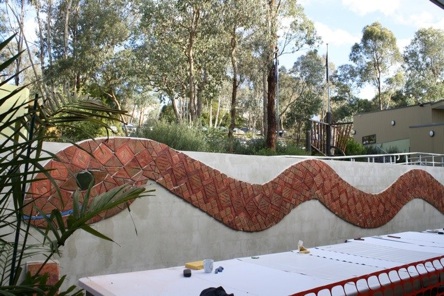
Mindi installed in the landscape
Our art installation, Mindi the Serpent, began with a suggestion from our Head of School that the long, bare concrete wall opposite the entrance of the school needed to be decorated. As the Art teacher it was my task to facilitate the creation and completion of the project.
The first stage began in 2012 when we connected with the Wurundjeri people who once lived and hunted in the area around Carey Donvale. This had a deep impact on our understanding and became the inspiration for significant elements of the final artwork.
My approach to the many stages involved in the project’s design and implementation was based on the philosophies, which underpin my teaching:
•To develop strong community networks both within and outside the school
•To provide collaborative learning experiences that connect students with each other and facilitate cooperation and respect
•To provide open-ended learning experiences which enable them to bring their own understandings to their ongoing education
•To involve students in the whole process of the design and implementation of a project
•To build in opportunities for all members of our community to be involved and to participate in the making of the work
We contacted the Wurundjeri people and the Koorie Heritage Trust to work with us and provide authentication and the historical and cultural setting for the work. I set about researching other communities who had worked in a collaborative way and found the Center for the study of Community in Sante Fe, New Mexico. This centre has undertaken considerable research in collaborative projects.
Below is an excerpt based on their understandings:
Notes by Ed Margarson:
‘Communities: are places or entities where each member can give something, where they can contribute something that they feel especially able to give, something they are good at. The gift from each member is valued by the whole community and all gifts are unique and individual. The gift that community gives back to each member is that of a role and connection Community; is a dynamic set of relationships in which a synergic, self-regulating whole is created out of the combination of individual parts into a cohesive, identifiable, unified form. (is this whole paragraph a quote?)
Collaborative learning communities – the whole of these parts – combines each of the individual elements listed above into a vital, flourishing, and thriving living system. Every living system in nature has dynamics constantly at work to help it become a continually growing and renewing system.’ Center for the study for community, Santé Fe, New Mexico
http://julieboyd.com.au/wp-content/uploads/SCHOOLS-AS-COLLABORATIVE-LEARNING-COMMUNITIES-2010.pdf
Ed Margarson states that he is very aware of the impact educators can have on the students in their care and the opportunities available to make their learning an exciting and fulfilled experience. Through using art, it is possible to help students make sense of their world through collaboration, image making, exploration and imagination.
If we can respect this, and understand our students’ needs, they will grow and learn as individuals. Each artwork we create tells a story about who we are. This year students will have the opportunity to put their individual thoughts together in a collaborative manner to tell the story of the Wurundjeri people.
Working collaboratively enables us to feel supported and part of a team whilst also developing personal self confidence and resilience. Sharing our knowledge base and expertise allows us to provide richer experiences for our students. When learning is meaningful and allows for challenges within secure boundaries, then the rewards are great.
Each day I witness energy and enthusiasm, as children arrive at the art room door full of imagination and a zest for life and learning. Their first question is “What are we making today? Can I start?” Their journey begins, and so does mine.
Such is the advantage of being a teacher – we are instantly refreshed by new eyes and a new vision and there is nothing more tangible than becoming a part of the child’s learning.
As an educator I believe that the best gift I can give my students is not just the passing on of knowledge and information but also connecting to and combining with the skills of other educators. When we share our abilities we create a creative force stronger than what the individual can produce alone. I am hopeful that through these projects I can help the students understand the importance of working collaboratively with the community as a life skill.
Our art program already offers the basis for individual creative development no matter the age, skill level or academic performance. Students are also immersed in making real connections with literacy, numeracy, science, language, culture and social issues through their art projects. They are encouraged to learn new skills, discover new cultures, accept difference, and to understand how subjects like math and science, relate to art and to the world around them. Although they are encouraged to work across disciplines, I am not sure that they always understand the connections that are made. My question is: Have I made the idea of community and collaboration clear in my teaching? It will be my aim to create a better understanding about this integration as we go forward together this year on yet another adventure.
So in the second stage of the process students were encouraged to work alongside me to gain an understanding of the steps that are necessary to design and make our finished work. Together we solved the practical, mathematical, creative, and artistic problems that arose. Involving the students in the design process and discussing the issues that needed to be resolved was paramount. We looked at how we needed to create a whole collaborative work, allow for individual expression and also provide an informative installation that was true to the Wurundjeri people.
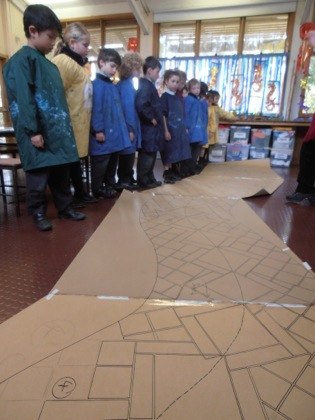
Students discussing the design
The final stage has been a tapestry of our school community’s individual talents and hopefully proves to students that together we can create powerful works of art that are there for perpetuity for all to enjoy. It is anticipated that the viewer will also be informed through the written excerpts that speak of the culture of the Wurundjeri people embedded within the work.
Students gained an understanding of the need for the work to make a connection to the space in which it will be installed. They learnt about the culture of the tribe who have been in our area for over 40,000 year. They considered the choice of materials to be used in the construction of the work and its potential to reflect the subtleties’ of the environment and the symbolism of the serpent Mindi. This serpent is greatly respected by the Wurundjeri and it was therefore paramount that the finished installation sit in harmony with the landscape.
As a community we worked with both the Wurundjeri people and the Koorie Heritage Trust for authenticity and guidance. This experience created real connections. Other staff have supported us by integrating the project into the classroom curriculum. Year 3 students worked in their library sessions with our dedicated Librarian Robyn Sunberg to respond to the overall environmental issues that relate to our Wurundjeri. This opportunity for other specialist teaching staff to be involved broadened their understandings beyond the art room providing a rich background for our project.
The question that our Librarian posed for the students was:
In groups of 3 pretend you are Wurrawee (a young indigenous person) looking at the Wurrundjeri area now…. 200 years after they have lived here.
What things would they want us to change?
Here are some of the answers.
4F-
Matt, Yash and Sophie:
•We don’t take up their space.
•We don’t pull out so many plants.
•We should only take what we need.
Lucas, Daniel and Abbey:
•Add more native plants to the area
•Give the Aborigines their land back
•Respect the culture- land animals, ceremonies and space.
Aiden, Serena and Claire:
•Don’t destroy the animals, trees and plants
•Stop Pollution
•Replenish what we take from the earth
Some very strong mathematical studies made been made around the process of creating Mindi. Year Three students have been given calculation tasks related to the work, such as how many tiles are in the work? How many hours has it taken to make the installation? How long does it take to lay 10 tiles?
To what degree are these evident in your classroom?
This was my question and the challenge throughout this story.
Photo Maths Yr 3
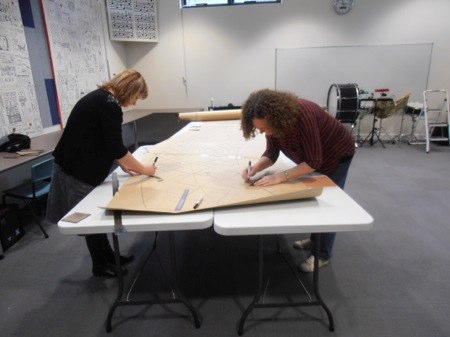
Transferring our design onto the template with parents assisting
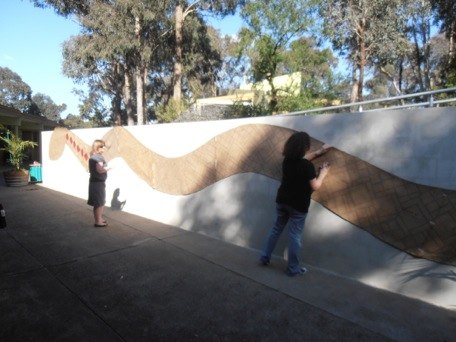
Parents place our design on the wall so that we can mark the space and ensure that our design will work.
In developing a rich backdrop to the work we also wanted to be clear on the overall learning intentions involved and how we might use multiple disciplines in the project. This was achieved through:
•Researching the Wurundjeri thoroughly and immersing students in every aspect of the study using all of the resources at our disposal such as technology, literature, outside resources such as guest speakers, other peers and local community connections.
•Students created visual and written reflections of their understandings through classroom studies / image making in the form of paintings, line drawings, printmaking and 3D materials.
•They were been introduced to the language of the Wurundjeri people, their history, local symbols and story lines
•Students were engaged in open discussions on the actual practical implications of creating a collaborative work that is all inclusive and that celebrates the individual, our community and most importantly is sensitive to our local Wurundjeri people
•Classroom teachers became involved in integrating the project into their curriculum. An example of this was students being brought out to the wall to develop math’s questions around the installation.
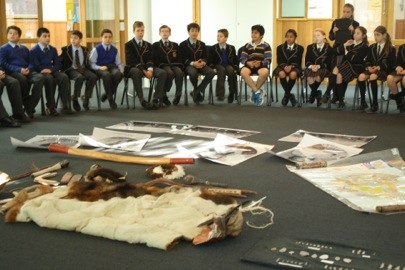
Below Wurundjeri Elder speaks with our upper classes.
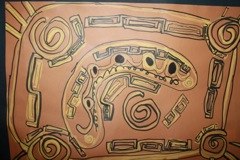
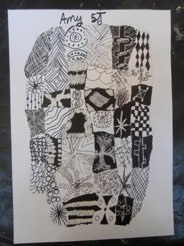
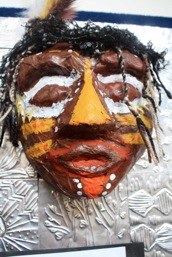
Line drawing based on cave paintings and black and white drawing of a possum skin cloak.
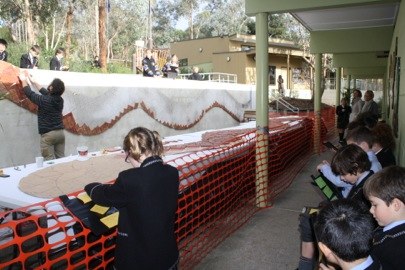
Classroom teachers take their students out to the wall and use their mathematical problem solving skills as our serpent is installed.
With this engagement in the project set in place we moved on to the more practical aspects of creating the parts that will make up our serpent and how this might play out. We commenced by running workshops for both parents and staff.
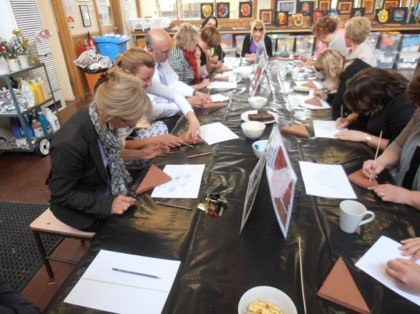
Staff workshop to carve tiles for Mindi.
All staff, students and parents have individually participated by attending workshops in the Art room. Each group was given a defined role. The students carved the creatures and symbolic patterns, and used the language of the Wurundjeri on their tiles. The parents’ tiles represented the Wurundjeri patterns and surrounded the written excerpts that travel along the spine of the serpent. The teaching staff carved tiles for the head of the work using only the patterns of the tribe. The tiles were laid out so that we could collaboratively decide on the decoration method. Students discussed the practical methods and which techniques would be more effective and through discussion made decisions and about how the work would provide the information and historical context for the viewer.
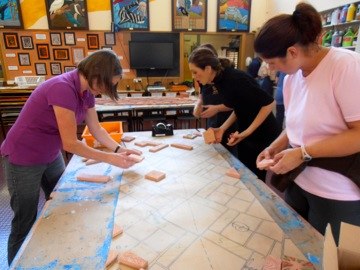
Our parents lend a hand putting tiles in place. It is like a giant jigsaw puzzle. There are over 900 hand carved tiles in our Serpent
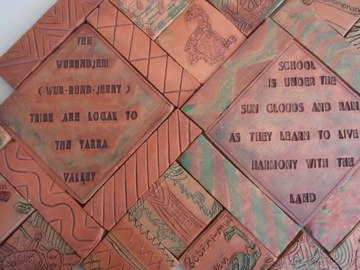
A section of our installation showing the written excerpts that provide the viewer with the history and culture of the Wurundjeri people
For my own research into the understandings of collaboration and how it affects teaching practice, I looked to the Global learning website.
Schools as collaborative learning communities
Carole Cooper and Julie Boyd
Global learning communities
http://www.vision.net.au/~globallearning
By Carole Cooper and Julie Boyd
The head office for Global Communities is in Launceston Tasmania.
The foundation of a collaborative learning community is collaboration – working together for common goals, partnership, shared leadership, co-evolving and co-learning – rather than competition and power given to only a few. …… The focus of the collaborative learning community is learning - learning where students are actively demonstrating their understanding, rather than students passing written tests as the sole sign of knowing. Learning that is based on conceptual understanding and the ability to apply this knowledge in a variety of contexts is a primary goal within a collaborative learning community. It is a new way of thinking for most educators (and the public) to know that all students can and will learn, that learning needs to be demonstrated, that it is important to learn not only the facts, but also conceptual relationships of ideas and the processes and positive attitudes of learning. There is much talk of thinking and problem solving skills, multiple intelligences, learning styles and fostering creativity; yet, implementation of these ideas is often relegated to separate programs. They have not been embedded in each and every thing that is taught. Putting the focus on student learning, rather than teacher telling, or covering the content, means:
1.Student takes responsibility for his or her own learning
2.Learning experiences are geared to student’s interests and needs
3.Students are actively engaged in learning in a variety of groups and contexts
4.Learning is understood, applied and internalized
Collaboration and learning happen within the context of community – a creation of unity through appreciating and celebrating diversity. In addition, the schools reflect the population and background of the larger community; therefore, collaborative learning communities help students learn the attitudes, knowledge and skills that benefit all in the community and community members become partners in facilitating and expanding the learning process.
Sense of shared purpose
Respect for difference
Agreement on core values
Acceptance
Participation
Trust
Communication
Collaboration
Commitment
Reciprocity
Conscious choice
Accountability
Shared responsibility
Efficacy
Equity
Perceived skill
Openness
Cohesion
To what degree are these evident in my art sessions classroom?
This was my question and the challenge throughout this story.
We now have our serpent installed and the outcome has been a rewarding and enriching experience for all of us. The above characteristics are very evident in the completed work and the process that we took. All parties feel extremely proud of their achievements. There have also been ongoing integrated projects initiated by other staff.
In the midst of assembling all of our individual parts together to create Mindi we celebrated Reconciliation Week – a stark reminder of the need for all of us to work together toward a common goal and to ensure that the connections we make with one another are clearly understood.
What does reconciliation mean? Reconciliation – the action of making one view or belief compatible with another / the restoration of friendly relations. (Oxford Dictionary)
The following is an excerpt from the Australian Reconciliation Association:
http://www.reconciliation.org.au/ - about us
Excerpt:
“Reconciliation Australia - Who we are?
Reconciliation Australia is the national organisation promoting reconciliation between Aboriginal and Torres Strait Islander peoples and the broader Australian community.
Our vision is for an Australia that recognises and respects the special place, culture, rights and contribution of Aboriginal and Torres Strait Islander peoples; and where good relationships between First Australians and other Australians become the foundation for local strength and success; and the enhancement of our national wellbeing.
Our programs such as the Indigenous Governance Awards Project and the Reconciliation Action Plans, along with our advocacy and public education work, are about building sustainable frameworks for lasting change in Australia.
What is reconciliation?
There’s no single strand to reconciliation—and it is not an easy or straightforward process. What is clear however is that reconciliation is everyone’s business.
Reconciliation is about building better relationships between Aboriginal and Torres Strait Islander peoples and the wider Australian community for the benefit of all Australians.
If we are to improve relationships between Aboriginal and Torres Strait Islander and other Australians we need more people talking about the issues and coming up with innovative ways to create positive change.”
Our collaborative project represents one innovative way to create positive change.
I commenced this project not only to visually enhance a neglected wall but to gain a better understanding of whether the connections we make when collaboratively working together are actually understood by students. This journeyhas taken on another dimension, that of our Indigenous culture and the relationship we have with our local tribe. On reading the above excerpt from the Australian Reconciliation website I have realised that the students and I are both having to make sure that the connections we are making with this work are real and authentic. The concept of building close ties with our Indigenous people is now as strong for me as for the students, especially in regard to my own beliefs and understandings. How do we find ways to continue our relationship with the Wurundjeri and how together we can make a difference in our immediate world?
The notion espoused by Reconciliation Australia that we need to develop innovative ways to create positive change could be reflected in our project as an example of this. We enjoyed developing a relationship with the Indigenous people we were working alongside and nurtured a shared vision. The aim of this collaboration was to educate a wider audience about Wurundjeri culture through our artwork.
Reflection on ones work is always of utmost importance and a valuable learning exercise. As a community we looked back on our collaborative project and what it has meant to the students, staff and parents that have worked to create our serpent Mindi. Each day as we view the work we appreciate the power of working alongside our Wurundjeri friends and what we have achieved together.
Student and staff reflection statements ;
A year 4 student shares her thoughts:
'Firstly we talked about the story of Mindi, the giant snake, in class. Mindi is from a traditional story of how Australia was made. We talked about Aboriginal patterns that the 'Wurundjeri' people used. We did 4 different examples of how to do our tile using these patterns. We could also include wombats, koalas, emus, kangaroos, gum nuts and gum leaves. We chose of these examples we did and drew it onto a clay slab. It made up part of the mural. We put the tile in the kiln and after they had been fired Mrs Jennings put them up in the shape of Mindi. I think the mural is really, really professional and beautiful. It was really fun trying to find my tile on the snake. It feels really nice to have a piece of your work in an artwork. They should put lights on the mural at night so it looks more effective.'
Our Head of school reflects on the Community based side of the project:
‘The Mindi project has provided a wonderful opportunity for our students to learn more about the culture of our local Wurundjeri tribe through the visual arts. This stunning mosaic mural has contributions from every area of Carey Donvale, including all students, our parents and the staff. As such it has further unified an already tightly knit community. Taking pride of place at the entrance to the school, the work of art will forever tell its indigenous story and generations to come will be able to learn about 'Mindi' the protector of the children.
We are very much looking forward to acknowledging the work of all those involved in a ceremony early next year. The local aboriginal elders, who acted as consultants throughout the entire project, will play a key role in this important celebration. Jeanette Jennings deserves enormous credit for her expertise, creativity and drive. Through the children, her vision has been realized in spectacular fashion.’
Sharing this project with the Wurundjeri people has created a strong friendship and has extended into yet another visionary project.
This further venture has seen myself and two other Indigenous artists work on a community based Mural with ‘Bunjil - The Wurundjeri Creator’ as the main focus. The shared vision for this project has been developed through discussion with Bill Nicholson an Elder of the Wurundjeri, two other Indigenous artists, the Arts Officer from the City of Knox, and myself as the leading artist. It has been a privilege to be respected enough to work alongside these artists in their own field.
The overall project has included other community members from varying groups such as Gardening groups, the local St Josephs School where Indigenous students board, the local BMX club and an open invitation to all community members.
Through our community work together we have provided our students with considerable knowledge about community and what it means. We will also hopefully have a new found permanent alliance with the local Wurundjeri people and have a permanent record of their culture in the public arena.
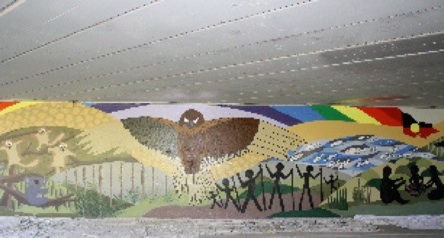
Our Bunjil Mural: A Reconciliation Project with the Wurundjeri artists and the local community.
Art Educator / Community Artist
Awarded the VIT Teacher of the Year award 2011 Jeanette is currently employed as an Art Specialist at Carey Donvale. Alongside this role continuing to work as a practicing artist and consultant, designing and project managing public works of art for local government authorities and other schools. A passionate advocate for cross curricula integration in education she regularly speaks at arts conferences both Nationally and Internationally. Case studies of teaching practice have been included in several publications including Teaching and Learning through the Contemporary Curriculum, Transforming schools through Collaborative Leadership and regular articles in various educational magazines. Jeanette believes that artistic pursuits assist children to be creative thinkers. This philosophy underpins her approach to education. As an artistic resource she provides consultation across all sectors of the educational system through educational journals practical workshops and curriculum based products on her website.
Mindi: Our Story

Monday, June 30, 2014

Download the PDF HERE