My Blog
Karen Chaur
The Best Worst Decision of My Life
Karen Chaur
How being a risk taker can lead to a growth mindset
I fell into teaching. It wasn’t that I chose it as a ‘vocation’ or a ‘calling’, as my Catholic University liked to imply, when they would preach to us about what a morally commendable choice we had made. About how we were going to ‘shape lives’ and ‘give back’ and ‘make a difference’. No, I fell into teaching because my parents valued academics and not the fluffy design stuff about which I was so passionate. Interior design was something for weekends and spare time – not a worthwhile career, nor academic enough for the daughter of a school Principal and Surveyor and the twin sister of an Engineer. I fell into teaching, went to the Catholic University, fulfilled the requirements to graduate and found myself in a classroom with 28 pairs of 10 year old eyes looking at me, summing me up, deciding whether I knew my stuff … they sorted me out in days…. no, in minutes and they saw straight through me! I wasn’t there because I wanted a ‘vocation’, I wasn’t there to ‘give back’ and make a difference’, I wasn’t there because of any religious calling, I was there because I fell into it and didn’t know what else to do.
My first few years were appalling now that I look back on it. I was conscientious enough to always be planned, punctual and polite, but I didn’t love my job. I questioned what the hell I was doing but I didn’t do anything about making a change or making this a career or being truly honest with myself. I plodded. Did my job. Did all that was asked of me. But… I hated it! I resented every day. I hated that my friends had careers they loved. I hated that my friends could listen to the radio while they worked. I hated that my friends could go to the toilet when they wanted to. I hated that my friends could go out for lunch. I hated that my friends were never questioned nor scrutinized by their clients like I was. I was becoming bitter and resentful and negative. I was even annoying myself.
I don’t know how it happened really but somehow about ten years later, I convinced my husband that I was creative enough to give something else a go. I wanted my own business. I wanted to be creative. I wanted to be free of bells and parents and demands. I wanted to pursue my dream and use my passion for interior design. An opportunity arose. A wholesaling company that imported and sold homewares was for sale. It was less than the value of our house so we could easily fund it by redrawing on the mortgage. The 2000 square metre warehouse was only fifteen minutes from our home. There were 3,000 customers Australia wide. The business had 9 staff who all knew what they were doing… There were two guys in fluorescent jackets in the warehouse. There was an office administrator, an accounts receivable and an accounts payable girl. All I had to do was to design and order stock. It was a match made in heaven. The deal was struck and I resigned from my Independent Catholic Girls School teaching role and launched into being a homewares designer, importer, supplier and answer to every homemaker’s dreams. I loved it! I was free and creative and in charge. I went to trade fairs overseas and liaised with foreign suppliers to have prototypes of my own designs made. I designed luggage and jewelry and glassware and doorstops! I approved the products day after day and within months I had a full warehouse of gorgeous products just waiting for appreciative consumers to buy! I secured a 30 square metre stand at the gift fairs in the capital cities and I set up my products as a chef plates up a gourmet feast. It looked superb! I was sure I would break all sales records and be the most successful stand at the fair!
To my dismay, the customers who came ordered in a lot smaller quantities than I anticipated. It wasn’t my gorgeous glassware nor jewelry nor designer luggage that sold…oh no…it was the tackiest stock that I had ‘inherited’ in my purchase price that was the best seller. It was the first product that I had deleted and thought of as ‘bad taste’. It was the foulest product that I was running out and never ordering again. The best selling item was ‘a cat’s bum!’ Literally, a cat’s bum! It was made of rabbit fur and was jammed in the boot of a car. Tacky tacky best selling crap! I couldn’t believe it. I had spent thousands, no tens, no hundreds of thousands of dollars on stock that I considered to be possible best sellers but the item that I hated, with which I didn’t want to be associated, was the one that sold the best. I had no cash left to re-order it and I didn’t want to re-order it. What on earth was happening?...
Proof of the bad taste I had inherited!

It took less than 18 months to whittle the staff down from 9 to 2. There were no fluorescent jacket wearing staff in the warehouse. There was no office administrator nor accounts receivable and accounts payable staff. There was no buyer nor sales reps. There was me and my friend Michelle who believed in what I was doing and who stood by me til the end. I got my forklift license, and got working. I ran the office during the day and picked and packed stock after hours. My family barely saw me and I was miserable. I hated fluorescent jackets. I hated retailers. I hated suppliers. I hated trade fairs. I hated boxes. I hated homewares. Most of all I hated cats bums.
We sold our house. Liquidated the stock. Closed the doors. Paid the bank and started again.
I returned to teaching.
Reflection leads to growth
“I have not failed, I have just found 10,000 ways that don't work.”
Albert Einstein
As the song goes ‘you don’t know what you’ve got til it’s gone…’ Once the loss of our home and the upheaval of our lives had settled, I reflected and realised that in fact I love teaching. I believe it is rewarding. It is fulfilling. It is creative. It is like designing stock for a global market … but the customers love it. They appreciate originality. They appreciate if things are new. They enjoy the thrill of new designs. They express joy in something that has been thought out and planned and set up to look appealing. They ask for more. They will re order and give thanks and show you how they have used your product. I believe kids are the best customer of all …. And they don’t leave you with a bad debt.
So what has changed?....I haven’t. I still love design and being creative. I still long for freedom, and lunches with my friends. What has changed is that I have found a program that reflects my pedagogy and that encourages creative thinking and innovation.
That program is the International Baccalaureate’s Primary Years Programme. What is different about this programme? It is conceptual and inquiry based. It is transdisciplinary. It requires students to make connections and encourages action as a result of learning. It is based on constructivism, which credits the experience and knowledge children bring to the classroom and builds on it. It is internationally minded and global in its thinking. It develops independence, and encourages curiosity and enthusiasm for learning.
I have benefitted from my mistakes. Not because I set out to make mistakes nor did I think I was ever going to benefit from the best worst decision of my life…. No, I have benefitted from my mistakes because I bounced. I had to. I bounced head long straight back into a career that I had run from. …. And I am thankful for it. Without this mistake, I wouldn’t have had the opportunity to look at teaching through fresh eyes. I wouldn’t have learnt to look for the best things in a day. I wouldn’t have learnt to value mistakes and to learn from them -to appreciate the learnings and second chances that life sometimes gives.
Mistakes are what help us learn. Celebrating mistakes takes us closer to success -developing what Dweck describes as a ‘growth mindset’ (1) Through developing a willingness to be a risk taker and then learning from the outcome, whether it be success or failure, growth occurs. Albert Einstein is credited with saying “I have not failed, I have just found 10,000 ways that don't work.” As well as learning from our attempts or the 10,000 ways that don’t work, we also build resilience and persistence. Recognising the importance of this in developing the PYP Learner Profile attribute of Risk Taking, I decided to explore whether students valued mistakes. Did they see these as failure or as opportunities for growth?
I asked my Year 4 students, “Has there ever been a time where you’ve taken a risk and then things haven’t worked out?”
‘I swapped soccer teams’ said George.
‘Tell us what happened’.
‘Well…let’s just say it didn’t go too well.’
George explained how the team he joined had a player in the position that he liked to play and that he felt he wasn’t playing as well because he didn’t know the people on the team.
‘What did you do to fix things?’ we asked.
‘Well I just kept going to training and now it’s my second season and the other boy has gone up to the next age group, so now I can play the position I want to….and I have also made some new friends on the team so I like it much better.’
This led us to discussing perseverance and the importance of George sticking to the sport he enjoyed and showing them that he was committed. ‘I wanted to go back to my old club but mum and dad said I couldn’t’, George explained. ‘They told me that my old team would have filled my place and so if I wanted to play soccer then I had to stick with my new team.’
I was pleased that this example had shown the students that not giving up could eventually result in better things happening for us.
Several other students then offered examples of times they had regretted a decision but then learnt from the experience.
‘It’s like life sometimes has a moral to the story,’ said Bethany, “Sometimes we learn important things from events that happen to us.”
“Can you give us an example?” I asked.
“Well, when I changed schools to come here I was really scared and I thought it was a bad decision but now I am happy and I have made new friends. If my parents had let me leave then I wouldn’t be here and having so much fun.”
“What is the moral to this story then Bethany?” I asked
“To never give up and to keep smiling so that people know you are a fun person to be around.”
Bethany’s parents had obviously given her some positive advice and had encouraged her to have confidence and believe in her ability to make friends.
The moral is….
I decided to set my students a challenge. Tell me about the ‘Greatest best worst mistake of your life.’ Students were asked to reflect on a time when a mistake had led to great learning. I shared with them my business aspirations and the exciting result,.. that this led me back to teaching. I was careful not to say ‘failed business’ as I didn’t want them to think that mistakes were failures. Failures can be mistakes but mistakes lead to opportunities. To begin, they illustrated a time they had tried to do something but had struggled. They then wrote and drew what they did to help them improve. They included their ‘self talk’ and the thought processes that led them to success.
Students shared strategies they had used to help them succeed such as ‘Saying in my head ‘I can do it’ loads of times’ and ‘thought encouraging thoughts’. Using a morphed thinking protocol, students listened to each other’s reflections and had a ‘listen, pair, share’.(3) They listened to stories and shared reflections while I recorded anecdotal comments of their conversations. We decided that our response question to the story-teller should be ‘what was the moral to your story?’ This made them look for the learning in their life experience. The following work samples show how these students used a growth mindset to achieve success.
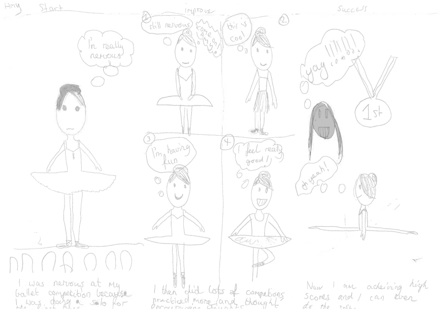
Here, Erin shows how her positive self-talk and determination led her to come first place in her ballet competition.
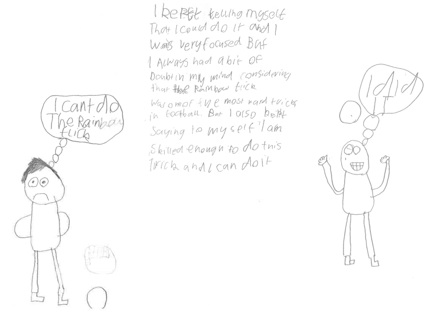
George uses language such as ‘I kept telling myself that I could do it and I was very focused’… he also admits to having self-doubt but goes on to explain that ‘I kept saying to myself ‘I am skilled enough to do this trick’ and ‘I can do it!’’
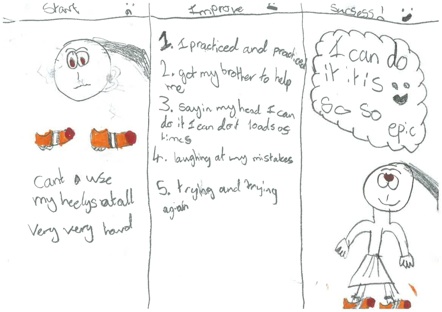
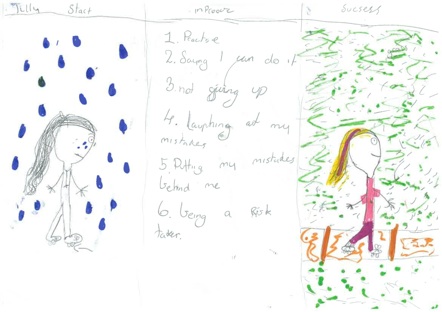
Brittany and Jade explained how they had struggled when learning to use their new ‘heelies’ (shoes with wheels in the heels). They both used the strategy of ‘laughing at their mistakes’ to overcome their embarrassment and to keep themselves positive. The girls shared this with the class and explained that by laughing they weren’t as embarrassed in front of their friends. April suggested that ‘if you don’t laugh at yourself, you end up giving up’. Another strategy they used was ‘putting mistakes behind me’ and ‘trying and trying again.’
These strategies and observations showed me that these students were beginning to understand what it meant to have a ‘growth mindset’ and to persist. We were getting somewhere.
The class discussion led us to conclude that ‘When we experience difficulty, or make mistakes, we can use this experience to recognise opportunity for growth.’ We discussed experiences such as getting test results and looking at our mistakes.
“These are perfect opportunities for learning.” I explained. “If we analyse the errors and work out where we went wrong, that brings us a step closer to achievement. The real learning happens when we recognise how not to do something.”
Students discussed this concept and realised that when they took time to look at where they went wrong, they were a step closer to realising how to get it right!
“These stories remind me of that book about Alexander” remarked Sophie. “Perfect!” I said. “Next lesson we will share that story together.”
We read ‘Alexander and the Terrible, Horrible, No Good Very Bad Day’ by Judith Viorst. And then pondered the question ‘Did Alexander have a growth mind set?’ We discussed each event in Alexander’s day and looked carefully at the illustrations. We looked for the growth opportunities Alexander had and the positive things we could see in his day.
Let's give students learning tasks that tell them, "You can be as smart as you want to be."
Carol Dweck 2010
“Here’s a challenge” I said, “We are going to ‘jigsaw re-write’ this story.” We talked about the ‘jigsaw reading’ protocol (Aronson) which we had used when researching and decided that we could use the same idea but could ‘rewrite’ rather than ‘read.’ We divided the pages of the book between the class, and in pairs, students set out to re write the book with a positive outlook and a growth mindset.
Our new version really tipped the original story on its head. We used the original illustrations as inspiration but the students identified the simplest things that Alexander had to be grateful for. Owning a skateboard, having cool hair, a fun at school, healthy food, lots of friends, new shoes and laughs with his brothers – there was a lot that was actually positive in his day.
When we compared our story with the original version, students made comments like ‘I hope that this will teach people how to be positive’ and ‘it is really easy to look at the world with a positive attitude, why do we get stuck in a negative mood? When you do it’s like that is all you see – the bad in the day. It is really easy to see the good. We need to make people see that.’ Our completed story left us all feeling really positive and satisfied that we had written a story with a lesson worth learning.
“What shall we call it?” asked one student. We brainstormed a new title, which could become the common phrase in each of the pages. “Alexander and the Fabulous, Wonderful, Amazing, Really Awesome Day!” became our new title. Conversations buzzed and discussions of new illustrations began.
We decided our positive version would be a book worth publishing. After all, the moral of the story was clear from the change in the title. “Life is what you make it!”
Insert link to completed ibook here
http://www.youtube.com/watch?v=0B_fLl5JhCo
References
1.Aronson, E Jigsaw Protocol at http://www.jigsaw.org.
2.Dweck, C. (2010) Even Geniuses Work Hard: Giving Students Meaningful Work, Vol 68, No 1 pp 16-20
3.Lymna, F. (1981). "The responsive classroom discussion." In Anderson, A. S. (Ed.), Mainstreaming Digest, College Park, MD: University of Maryland College of Education.
Karen Chaur is the PYP Coordinator and Teacher Librarian at Wardle House, Toorak College. She has worked in education for over twenty years with roles as an Art teacher, Teacher Librarian, Classroom Teacher and Curriculum Coordinator. Thinking life has career adventures that need to be experienced, she has also held roles working as a copywriter with the Austereo network, running her own homewares importing and distribution company, and being a parent. She is a qualified Primary Teacher, Teacher-Librarian, Copywriter and Forklift driver! Karen has recently completed her Masters of Education – PYP at the University of Melbourne Graduate School of Education. She has enjoyed the opportunity to combine her love of writing with her career in education when creating this Story of Learning.
The Best Worst Decision of My Life
Monday, June 30, 2014

Download the PDF HERE